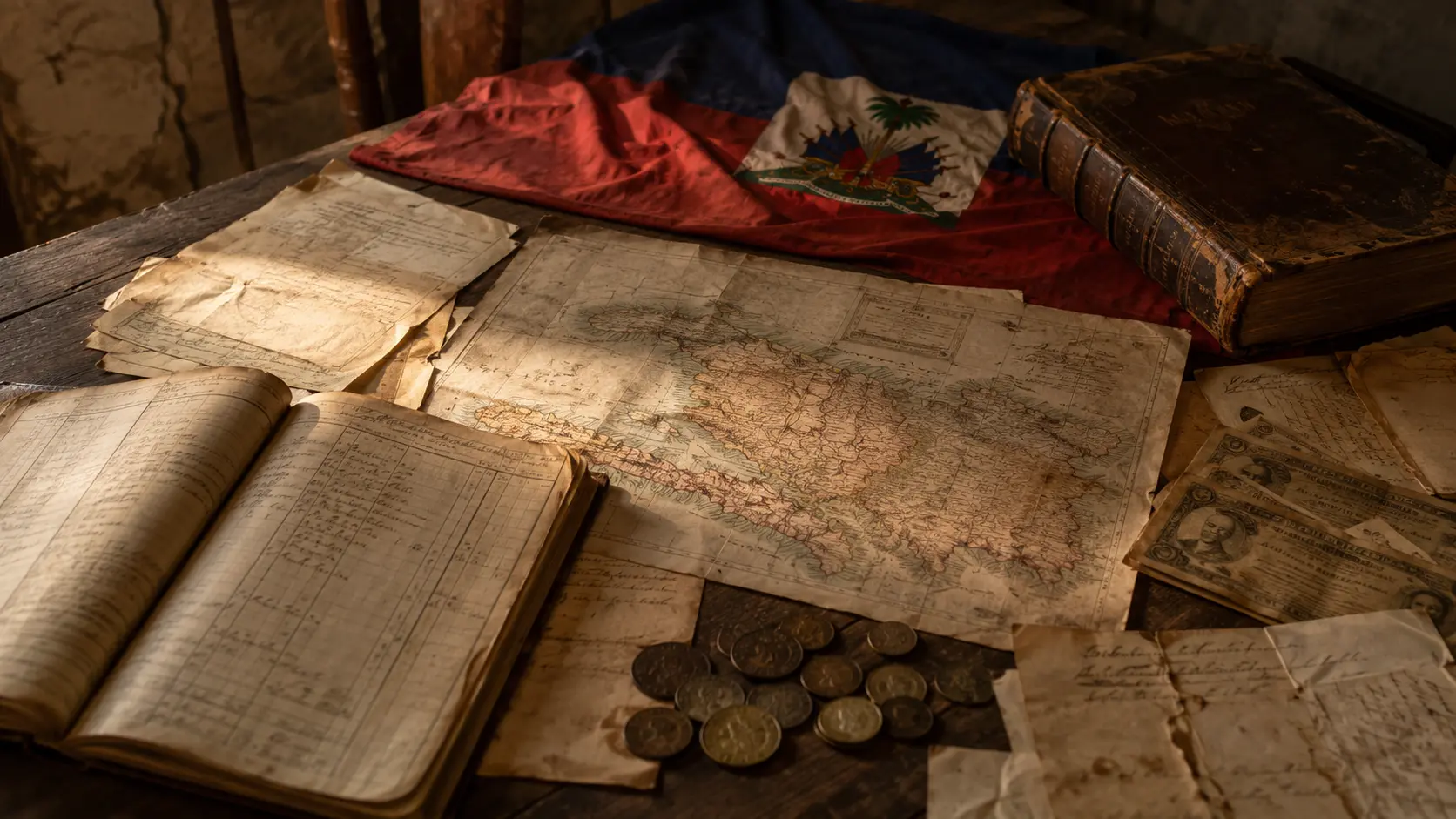
France’s Debt Demand: How Haiti Was Forced to Pay for Its Own Freedom
Haiti won its independence through one of the greatest freedom struggles in world history.
But freedom did not bring peace.
After the Haitian Revolution, Haiti was born into a hostile world. France had lost its most valuable colony. Slaveholding nations feared the example Haiti represented. Former colonists wanted compensation. And the new Black republic had to survive without the protection, trade access, and recognition that powerful nations often used as political weapons.
Then came one of the most painful chapters in Haitian history.
In 1825, France imposed a demand on Haiti: pay a massive indemnity in exchange for official recognition of Haitian independence. Yale’s Department of French describes the demand as 150 million francs, agreed to by President Jean-Pierre Boyer under threat of invasion. The case was extraordinary because formerly enslaved people were being made to compensate their former enslavers.
That is why this story is not just about money.
It is about power.
It is about punishment.
It is about a country that defeated slavery, then was forced to pay for the economic loss of the slave system it destroyed.
Haiti Was Free, But the World Did Not Treat It as Equal
Haiti declared independence on January 1, 1804, after a long revolution against French colonial rule. But independence on paper did not automatically give Haiti international security, trade equality, or diplomatic respect.
France and other powerful nations did not simply welcome Haiti into the world. Haiti’s existence challenged the racial and economic order of the Atlantic world. A Black republic born from a successful slave revolution was seen as dangerous by countries that still depended on slavery or racial hierarchy.
That hostility mattered because recognition was not symbolic only. Recognition affected trade, diplomacy, credit, shipping, and the ability of Haiti to function in a world controlled by empires.
France used that pressure.
By 1825, Haiti was facing a choice that was not really a free choice: accept France’s financial demand or risk renewed violence and continued isolation. Collège de France describes the 1825 arrangement as a treaty forcibly imposed on the Haitian Republic, requiring Haiti to pay 150 million francs to compensate former owners of Saint-Domingue who had left during the Revolution.
What France Demanded From Haiti
The French demand was simple and brutal.
France would recognize Haiti’s independence, but Haiti had to pay compensation to former French colonists. Those former colonists had lost plantations, land, and the enslaved people they had treated as property.
That means the victims of slavery were being made to pay the people connected to the system that enslaved them.
The original amount was 150 million francs. Collège de France notes that Haiti could only begin paying by borrowing from French banks, creating what has often been called a “double debt”: the indemnity itself, plus the loan taken to pay the first installment.
This is the part people must understand.
Haiti was not just paying France.
Haiti was borrowing from French financial institutions in order to pay France. That meant the young nation was trapped between political pressure, foreign lenders, and a debt burden tied directly to the legacy of slavery.
Why This Was So Damaging
A new country needs roads, schools, ports, hospitals, courts, farms, security, and stable institutions.
Haiti needed all of that after independence.
Instead, a large part of the country’s limited resources was pulled toward debt service. The Equal Justice Initiative summarizes The New York Times investigation by stating that Haiti’s revenues went toward servicing this “double debt,” depriving the country of schools, hospitals, and basic infrastructure while deepening a cycle of debt, poverty, and underdevelopment.
This does not mean the debt alone explains every problem Haiti later faced. Haiti also suffered from internal political conflict, elite struggles, governance failures, military division, and later foreign intervention.
But the debt demand created a historic burden at the worst possible moment.
Haiti was a young nation trying to build itself after slavery and war. Instead of investing fully in its own people, it was forced to satisfy a demand created by its former colonizer.
The Debt Was Later Reduced, But the Damage Continued
France later reduced the indemnity, but that did not erase the problem.
The New York Times historical debt dataset explains that the original 150-million-franc indemnity was later reduced to 90 million francs. It also details the complexity of the “double debt,” including the indemnity payments and the loans Haiti had to take on to service the demand.
The dataset also shows how Haiti borrowed 30 million francs in 1825 from a consortium of banks, but the bankers kept six million francs as commission, leaving Haiti with only 24 million francs to put toward the first installment.
That detail is important.
Even at the beginning, Haiti was not receiving the full benefit of the money it borrowed. Fees, interest, commissions, and renegotiations helped turn the demand into a long financial trap.
The Cost Was More Than the Amount Paid
When people talk about the Haiti independence debt, they often focus only on the amount Haiti paid.
But the real cost was bigger.
The real cost included the lost schools that were not built, the roads that were not improved, the institutions that remained weak, the public services that never reached the people, and the economic foundation that could not develop the way it should have.
The Equal Justice Initiative reports that The New York Times calculated Haiti paid about $560 million in today’s dollars to satisfy the ransom and related loans, and that if the money had stayed in Haiti’s economy, it would have added at least $21 billion over time.
That is why the independence debt is not only a history issue.
It is an economy issue.
It is a development issue.
It is a justice issue.
Haiti Paid for Recognition After It Had Already Won Freedom
This is the deepest insult of the debt demand.
Haiti had already won independence.
Haiti had already defeated French forces.
Haiti had already declared itself a nation.
But France still turned recognition into a financial weapon.
Recognition should not have required the descendants of enslaved people to compensate the descendants and associates of enslavers. Yet that is exactly what happened.
Yale’s conference description calls the 1825 arrangement an unprecedented case of formerly enslaved people compensating their enslavers.
That sentence alone explains why this history still hurts.
It was not normal debt.
It was not a business loan taken for national development.
It was not money borrowed to build Haiti.
It was payment demanded from a nation born out of slavery to compensate the people connected to slavery’s destruction.
The Debt Story Is Also Complicated
A serious Haiti Flash Back article should not pretend the debt explains everything.
Historian Alex Dupuy argues that the indemnity was not the only or primary reason Haiti struggled economically. In his abstract for “Haiti and the Indemnity Question,” he points to internal class conflict, political struggles, landholding issues, and later debts between 1875 and 1910 as major factors in Haiti’s economic difficulties.
That matters because honest history is stronger than propaganda.
France’s debt demand was unjust and damaging. But Haiti’s later struggles also involved Haitian elites, political conflict, state weakness, land issues, foreign banks, and U.S. intervention.
The stronger version of the story is not:
“Haiti is poor only because of France.”
The stronger version is:
“France’s debt demand placed a young Black republic under a heavy financial burden after slavery and war, and that burden combined with internal and external forces to shape Haiti’s long struggle.”
That is more honest. It is also harder to dismiss.
Why This History Still Matters Today
Many people talk about Haiti’s poverty as if it appeared from nowhere.
It did not.
Haiti’s economic struggle has roots in slavery, colonial extraction, war, diplomatic isolation, debt, bad governance, foreign intervention, and elite control. The independence debt is one of the clearest examples of how Haiti’s freedom was punished economically.
When a country has to pay for recognition, it starts behind.
When a country has to borrow from foreign banks to satisfy its former colonizer, it starts behind.
When money that could have gone into schools, roads, agriculture, and public institutions leaves the country, generations feel the impact.
This is why Haiti Flash Back cannot tell Haiti’s story only through today’s headlines.
To understand Haiti today, we have to understand what was taken yesterday.
What the Debt Demand Reveals
France’s demand reveals something important about power.
The same world that claimed to believe in liberty did not know how to accept Black freedom without punishment.
Haiti had done what people said was impossible. Enslaved people had organized, fought, defeated French rule, and built a nation.
But instead of being welcomed as a victory for humanity, Haiti was treated as a threat.
The debt demand was part of that punishment.
It told Haiti:
You may be free, but your freedom will cost you.
You may be independent, but recognition will come with a price.
You may have defeated slavery, but the former slaveholding order will still send you the bill.
That is the wound behind the numbers.
Haiti Did Not Just Pay Money. Haiti Paid Time.
Money can be counted.
Time is harder to count.
Haiti paid in delayed development. Haiti paid in lost opportunities. Haiti paid in weakened institutions. Haiti paid in generations of children who could have inherited a stronger country if more national wealth had stayed inside Haiti.
The debt did not destroy Haiti by itself. But it helped limit what Haiti could build during a critical period.
And that is why the story matters.
It is not about living in the past.
It is about understanding how the past shaped the present.
The Haiti Flash Back Lesson
The story of the Haiti independence debt is bigger than a financial agreement.
It is a warning about what happens when freedom wins politically but loses economically.
Haiti defeated slavery on the battlefield. But after independence, powerful forces found another way to keep pressure on the young nation: debt.
That is why Haiti’s history must be told with context.
Haiti was not born poor.
Haiti was not born weak.
Haiti was born from revolution, then forced to survive in a world that punished it for winning.
France’s debt demand did not erase Haiti’s victory. But it made the cost of that victory heavier than any free nation should have had to carry.
And if we are serious about understanding Haiti, we cannot skip this chapter.
Because Haiti did not just fight for freedom.
Haiti was forced to pay for it.