



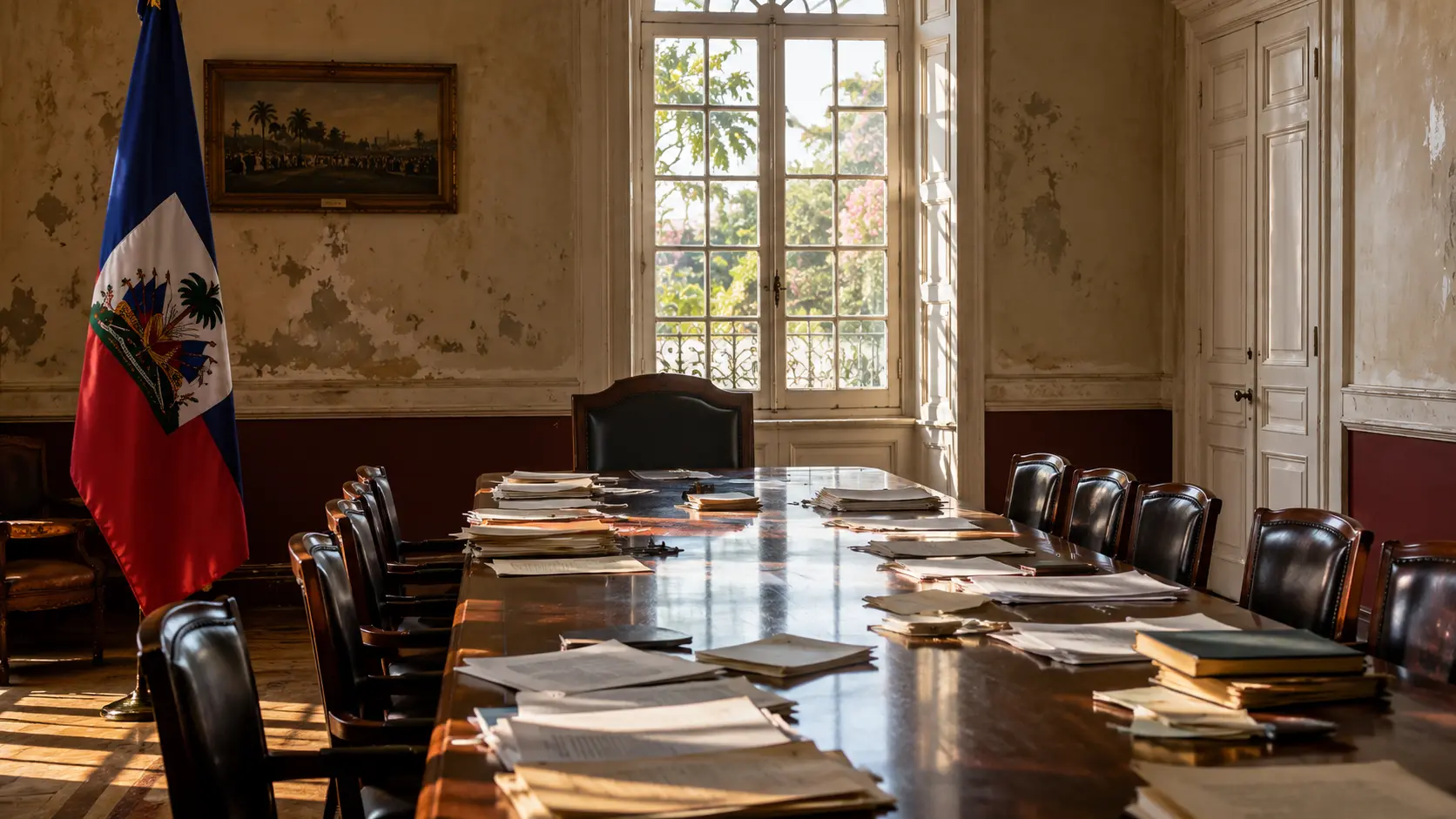
Why Haitian Politics Keeps Repeating the Same Painful Cycle
Haiti’s political crisis can feel like a movie that keeps restarting with different actors but the same ending.
A leader rises. Hope grows. Promises are made. Then comes division, corruption accusations, protests, outside pressure, insecurity, delayed elections, broken institutions, and people asking the same question again:
Why does this keep happening?
The answer is not simple.
Haiti’s political problems did not begin with one president, one party, one foreign country, one gang leader, or one election. The cycle is older and deeper than that. It is tied to Haiti’s history, weak institutions, elite control, corruption, poverty, foreign intervention, insecurity, and a government system that too often fails ordinary people.
That does not mean Haitians are destined to suffer.
It means the cycle has roots. And if people do not understand the roots, they will keep reacting only to the branches.
Haiti Politics Cannot Be Explained by One Bad Leader
One of the biggest mistakes people make when discussing Haiti politics is blaming everything on one person.
Sometimes the blame is placed on a president. Sometimes on a prime minister. Sometimes on the opposition. Sometimes on foreign governments. Sometimes on gangs. Sometimes on the rich families. Sometimes on the poor masses. Sometimes on the diaspora.
But Haiti’s political cycle is bigger than one person.
The Congressional Research Service describes Haiti’s post-independence history as marked by long periods of authoritarianism and political fragility, with foreign interventions and natural disasters shaping the country’s path. Since the fall of the Duvalier dictatorship in 1986, attempts to consolidate democratic rule have had limited success.
That matters because Haiti’s problem is not only leadership. It is structure.
When institutions are weak, every leader becomes too powerful or too vulnerable. When the courts are weak, justice becomes political. When elections are delayed or disputed, legitimacy becomes fragile. When police are under-resourced, armed groups become stronger. When public money is mismanaged, people lose faith. And when the people lose faith, the next crisis is already waiting.
The Shadow of Dictatorship Still Matters
To understand the modern political cycle, you have to understand what dictatorship did to Haiti.
From 1957 to 1986, Haiti was ruled first by François “Papa Doc” Duvalier and then by his son Jean-Claude “Baby Doc” Duvalier. CFR describes the twenty-nine-year Duvalier rule as a period marked by political repression, corruption, and widespread human rights abuses.
Dictatorship does more than control a country while the dictator is alive.
It damages institutions. It teaches people to fear politics. It turns government into a tool of loyalty and punishment. It weakens trust. It creates habits of silence, survival, and patronage. It teaches ambitious people that power is something to capture, not something to serve through.
When Duvalier fell, Haiti did not instantly become a strong democracy. The dictatorship ended, but the damage remained.
That is why the post-1986 period has been so difficult. Haiti had to build democratic life after decades of fear, repression, and centralized control.
That is not easy for any country.
Elections Alone Cannot Save a Broken System
Many people say Haiti simply needs elections.
Elections matter. A country needs legitimate leadership. People need the right to choose their government. But elections alone cannot fix a system if the institutions around those elections are weak.
Haiti’s first president elected in broadly free and fair elections, Jean-Bertrand Aristide, won in 1990. But he was ousted in a military coup the following year, and later returned after U.S. pressure and intervention.
That moment tells us something important.
Even when Haiti had a major democratic breakthrough, the system around it was not strong enough to protect the result.
That is the painful cycle: people vote, hope rises, then institutions fail to defend the democratic process. The public begins to believe that voting is not enough. Political actors begin to believe power can be won outside the ballot box. And each broken election weakens the next election before it even happens.
Weak Institutions Create Strong Men
When institutions are weak, politics becomes personal.
Instead of trusting courts, people trust allies. Instead of trusting laws, people trust connections. Instead of building parties around ideas, politicians build networks around loyalty. Instead of solving public problems, leaders focus on survival.
The World Bank’s Haiti diagnostic describes the country’s long-running fragility as driven by systemic capture, concentration of power and resources, patronage-based governance, unstable political settlements, high levels of violence, insecurity, and weak rule of law.
That is one of the cleanest explanations of Haiti’s political cycle.
The system is not only unstable because people fight for power. People fight for power because the system rewards whoever captures it.
If government contracts, protection, jobs, licenses, customs access, security, and justice depend on political connections, then politics becomes a battlefield for survival and profit.
That creates winners and losers.
And the losers do not simply accept defeat. They mobilize. They protest. They block. They form alliances. They wait for the next opening.
Then the cycle repeats.
Corruption Is Not Just Theft. It Is a Political System.
People often talk about corruption as if it only means someone stealing money.
That is part of it, but corruption is bigger than theft.
Corruption is when public office becomes private business. It is when state power is used to protect friends and punish enemies. It is when public contracts are awarded through loyalty instead of competence. It is when people stop believing that rules matter.
The World Bank identifies political instability, corruption, and fragility as major obstacles to Haiti’s economic and social development. It also points to elite capture, concentration of power and resources, and patronage-based governance as long-running drivers of inequality and grievance.
This is why corruption keeps producing political crisis.
When people believe the state is captured by a small group, they stop seeing government as legitimate. When government loses legitimacy, people turn to the street. When the street becomes the main political arena, instability grows. When instability grows, leaders use emergency power, armed actors, or foreign support to survive.
Then trust collapses even more.
Foreign Pressure Has Always Been Part of the Story
Haiti’s politics have never existed in a vacuum.
Since independence, Haiti has had to deal with powerful foreign countries, trade pressure, debt, occupation, aid dependency, diplomatic pressure, and international intervention. CFR describes Haiti’s development path as shaped by foreign interventions, chronic political instability, social unrest, and natural disasters.
Foreign involvement is complicated.
Sometimes outside governments say they are helping stabilize Haiti. Sometimes they pressure leaders to compromise. Sometimes they back certain political arrangements. Sometimes they send troops, police support, aid, or diplomatic missions. Sometimes they make things worse by supporting short-term stability over long-term legitimacy.
The honest truth is this:
Haiti’s crisis is not only foreign-made. Haitian leaders and elites have made many harmful decisions. But foreign powers have repeatedly shaped the political field, and that has often weakened public trust.
When Haitians believe leaders are chosen, protected, or removed by outside forces, the legitimacy of the state suffers.
A government can have international backing and still lack the people’s trust.
That is a dangerous combination.
Gangs Grew Inside a Political Vacuum
Today, it is impossible to talk about Haiti politics without talking about armed groups.
Gangs did not become powerful overnight. They grew inside a vacuum left by weak institutions, broken policing, political manipulation, poverty, and impunity.
CFR reports that after the 2021 assassination of President Jovenel Moïse, Haiti’s instability deepened into an acute security crisis. Violence soared in 2023 as gangs consolidated control of more than 80 percent of Port-au-Prince, and Prime Minister Ariel Henry resigned in April 2024 before a transitional presidential council was formed.
This is the political cycle at its most dangerous.
When the state is weak, armed groups become alternative authorities. They control roads. They control neighborhoods. They control movement. They tax people through extortion. They influence markets. They interfere with humanitarian access. They make elections harder or impossible.
Once that happens, politics becomes hostage to security.
And when security collapses, every national conversation becomes trapped in emergency mode.
The People Keep Paying the Price
The cruelest part of Haiti’s political cycle is that ordinary people pay for decisions they did not make.
When leaders fight, the people pay.
When elections fail, the people pay.
When gangs block roads, the people pay.
When foreign policy fails, the people pay.
When public money disappears, the people pay.
The World Bank says Haiti’s development continues to be hindered by political instability, increasing violence, and unprecedented insecurity, and that Haiti remains the poorest country in Latin America and the Caribbean. It also reports that violence and insecurity have displaced 1.4 million people as of March 2026.
That is not just data.
That is families sleeping somewhere they did not choose. Children missing school. Mothers searching for food. Businesses closing. Farmers unable to move goods. Students growing up inside fear. Diaspora families sending more money because the state cannot provide basic protection.
Politics is not abstract in Haiti.
Politics decides whether people can live.
Why the Cycle Repeats
The cycle repeats because the same ingredients keep coming back:
- Weak institutions
- Elite capture
- Corruption and patronage
- Disputed legitimacy
- Foreign pressure
- Poverty and inequality
- Insecurity and armed groups
- Public mistrust
- Delayed reforms
- Leaders focused on survival instead of rebuilding the state
The World Bank’s diagnostic says Haiti is locked in a crisis and fragility trap, where lack of shared prosperity worsens the same dynamics that produced the crisis in the first place.
That is the cycle.
Poverty feeds instability. Instability weakens institutions. Weak institutions enable corruption and violence. Corruption and violence deepen poverty. Then a new leader comes in and inherits a broken system while also benefiting from parts of it.
This is why changing faces is not enough.
Haiti needs changes in how power works.
What Real Change Would Require
Real change in Haiti would require more than another political slogan.
It would require institutions strong enough to outlast leaders. It would require courts that people trust. It would require police reform that protects citizens without becoming another political weapon. It would require elections that are credible, safe, and accepted. It would require public money to be tracked. It would require decentralization so everything is not trapped in Port-au-Prince. It would require a serious fight against impunity.
It would also require a different relationship between the state and the people.
The Haitian state cannot only appear as tax collector, police force, political office, or campaign promise. It has to become visible in schools, roads, hospitals, public safety, sanitation, courts, agriculture, and economic opportunity.
People trust government when government shows up in their lives in useful ways.
Without that, politics remains a fight between powerful groups above the people’s heads.
Haiti Does Not Lack Intelligence. It Lacks a System That Serves the People.
One insulting idea that must be rejected is that Haiti’s crisis exists because Haitians do not understand politics or democracy.
That is false.
Haitians understand power very well. They understand betrayal. They understand survival. They understand when leaders are lying. They understand when foreign governments are pretending to help. They understand when wealthy interests are protecting themselves. They understand when the poor are being used.
The issue is not that Haitians lack intelligence.
The issue is that the political system has repeatedly failed to convert public intelligence, public anger, and public hope into stable institutions.
That is why so many Haitians are tired.
They have seen too many promises. Too many transitions. Too many dialogues. Too many commissions. Too many international meetings. Too many leaders claiming they are different.
At some point, people stop asking for speeches.
They ask for proof.
The Haiti Flash Back Lesson
Haiti politics keeps repeating the same painful cycle because the country has never fully escaped the structures that produce crisis.
Dictatorship damaged institutions. Corruption weakened trust. Foreign intervention complicated legitimacy. Elite capture concentrated power. Poverty increased desperation. Gang violence exposed the collapse of security. And each new crisis made the next crisis easier.
But history is not only a warning.
History is also a map.
If Haiti’s problems were created over time, then the solutions must also be built over time. Real change will not come from one speech, one election, one foreign mission, one protest, or one leader.
It will come from rebuilding the relationship between power and the people.
That means Haiti needs truth before slogans. Institutions before personalities. Accountability before promises. Security before elections that cannot be safely held. And leadership that understands public office is not a prize. It is a responsibility.
Haiti’s political cycle is painful.
But it is not mysterious.
The same patterns keep producing the same results.
And until those patterns are broken, Haiti will keep changing leaders while the people keep living the same crisis.


